Learn · General Surgery · Intermediate
Acute cholecystitis
The gallbladder ultrasound from a Code Status case, and why gallstones alone do not make the diagnosis.
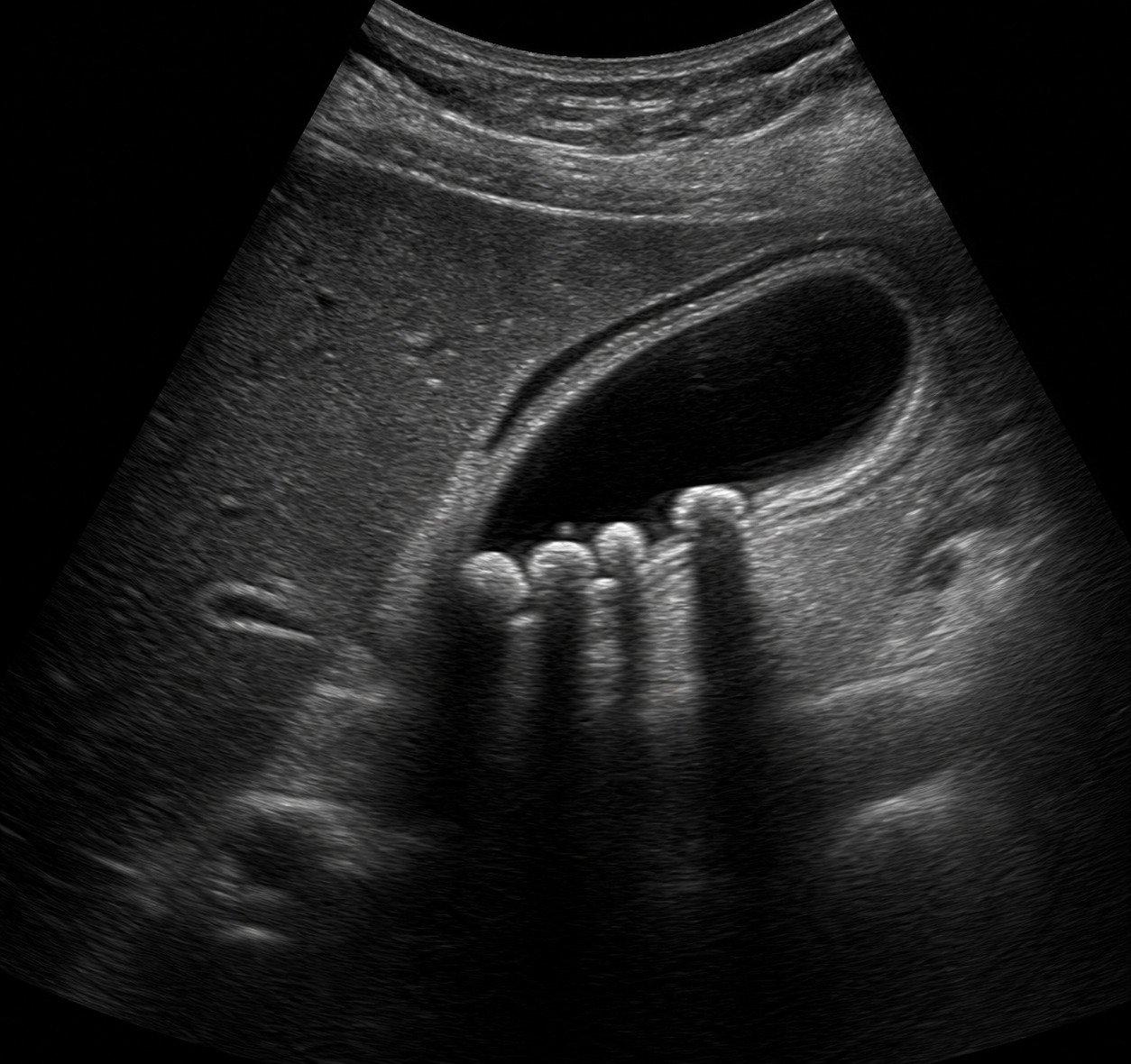
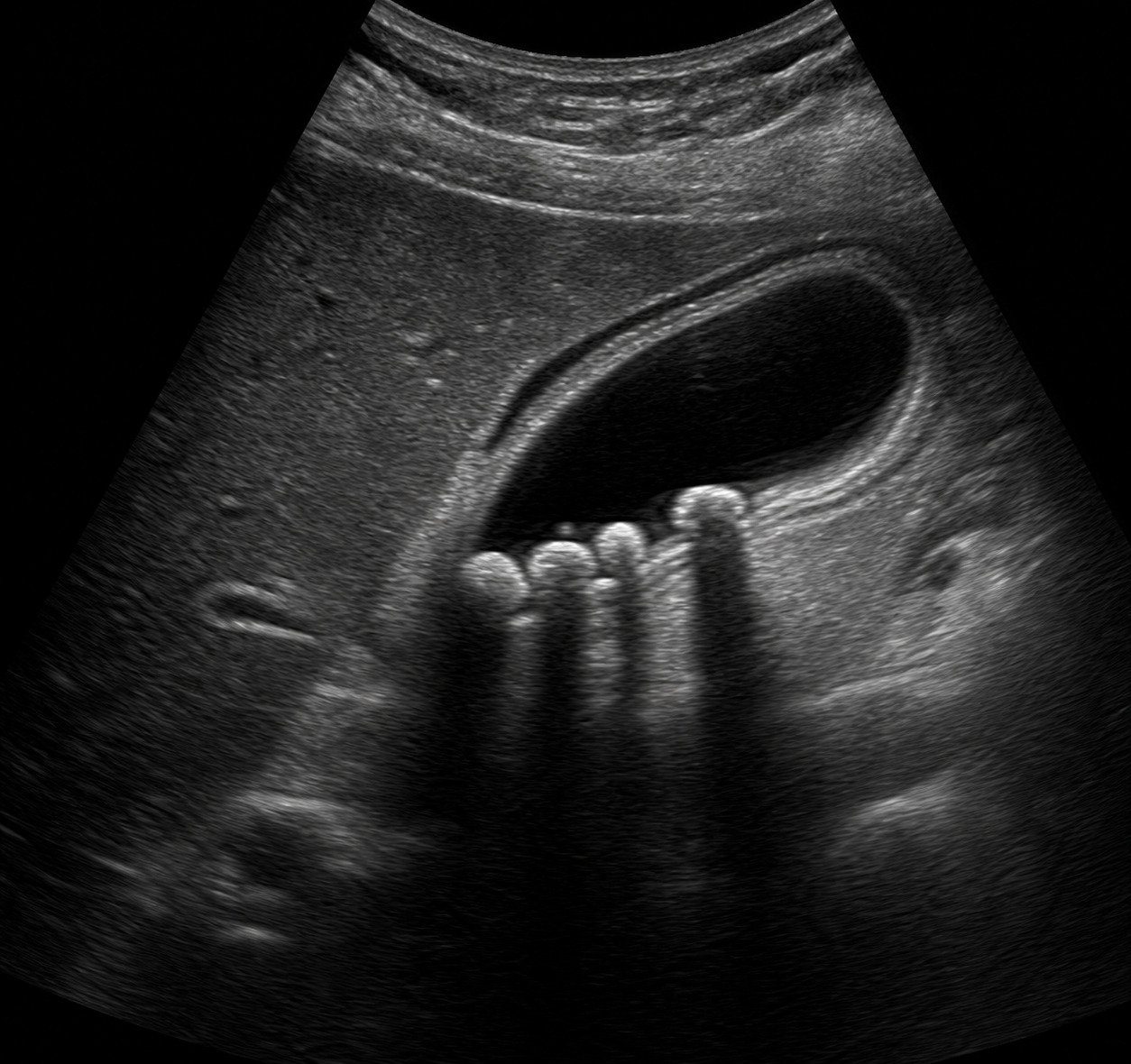
Bright gallstones cast dark shadows below them, and the gallbladder wall looks thick and layered. The top of the picture is nearest the probe.
Elena Martinez’s ultrasound, from her case. Open it full size
Reading this ultrasound
Find the gallbladder, the dark, fluid-filled oval in the middle. Several bright stones sit along its lower edge, each casting a dark shadow below it, because the stone blocks the sound. This is posterior acoustic shadowing, a classic sign of gallstones.
Now look past the stones to the wall. Along the top of the gallbladder it looks thick and layered: a bright inner line, a darker band and a bright outer line. That suggests swelling from inflammation. Stones with signs of inflammation raise concern for acute cholecystitis. Neither stones nor a thick wall makes the diagnosis alone.
Also look for fluid around the gallbladder (pericholecystic fluid) and check for a sonographic Murphy sign: focal tenderness when the probe presses directly over the gallbladder. A still picture cannot show that sign. Read the scan with the patient’s symptoms and examination. The same scan also checks the common bile duct, a separate question.
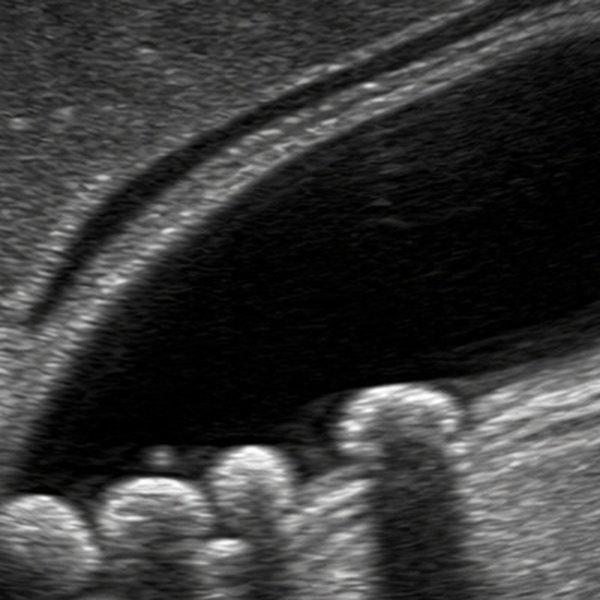
Gallbladder wall, enlarged
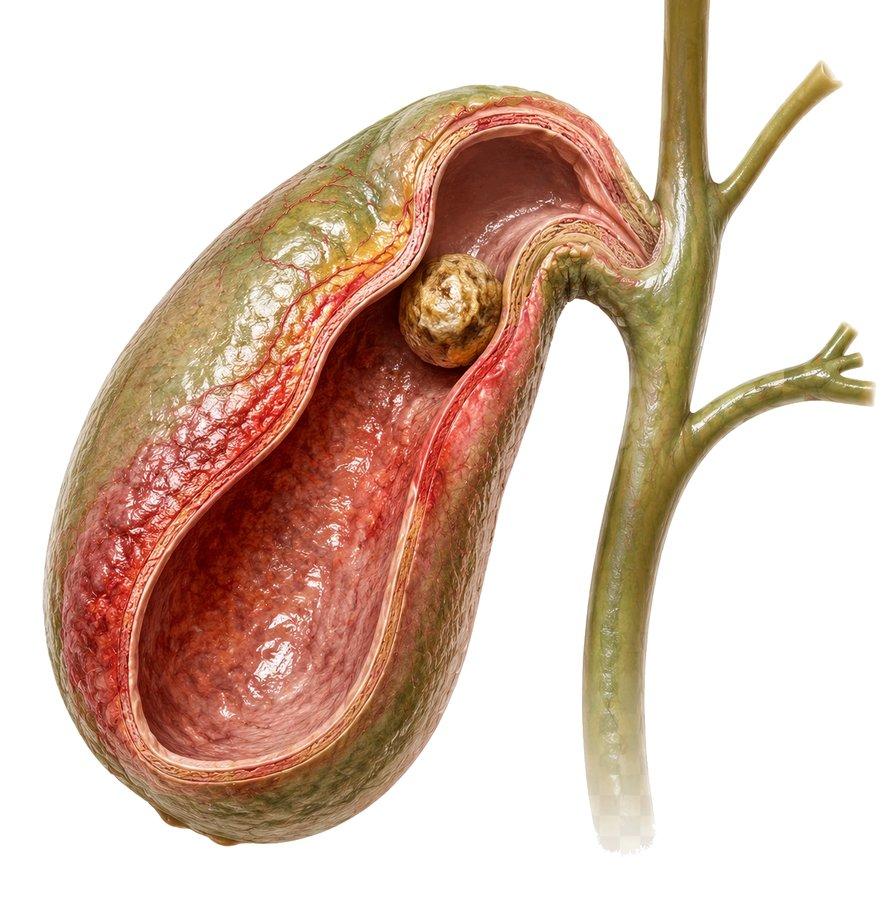
What is happening
A gallstone can block the cystic duct, the gallbladder’s outlet, so the gallbladder cannot empty. When the blockage persists, the gallbladder can become inflamed: acute cholecystitis.
In biliary colic the blockage is usually temporary, and the pain settles without that inflammation. That is why stones alone are not enough.
In the emergency department
Recognize the pattern, find the inflammation, then decide who needs surgery.
On arrival
Notice when the pain does not stop
Elena, 42, has had pain under her right ribs since dinner last night. It goes around to her back, near the shoulder blade. She has had pain like this four or five times before, after big meals, and it always settled within an hour or two. This time it stayed, she vomited twice, and she has a fever and a heart rate of 108. Pain that does not stop, with fever, raises concern for acute cholecystitis rather than uncomplicated biliary colic.
At the bedside
Look for inflammation
Check for tenderness under the right ribs and a Murphy sign: press there while the patient takes a deep breath, and sudden pain stops the breath. Fever and a raised white blood cell count support inflammation, but neither is required: early disease, older adults and people with weak immune systems may show little. No single symptom, examination finding or blood test makes the diagnosis. It comes from the whole picture.
Imaging
Ultrasound comes first
Ultrasound of the right upper abdomen is usually the first imaging test, and it uses no radiation. Look for gallstones, wall thickening, fluid around the gallbladder and a sonographic Murphy sign. If it is inconclusive, the next test depends on the question. CT can show complications such as a perforation or an abscess, or another cause of the pain. A HIDA scan follows a tracer through the bile system to see whether the cystic duct is open: if the gallbladder does not fill, that supports acute cholecystitis. It is highly sensitive, but it takes longer and is less available.
Before deciding
Check the bile duct
Where a stone lodges decides the problem. In the gallbladder, stones may cause biliary colic. A persistent blockage of the cystic duct can cause cholecystitis. A stone in the common bile duct (choledocholithiasis) can cause yellow skin or eyes (jaundice) and abnormal liver tests. Infection behind a blocked bile duct is cholangitis, an emergency: antibiotics, resuscitation and drainage of the duct, usually by ERCP, an endoscopic procedure. So check the bilirubin, the liver tests and the width of the duct. Mild liver test changes can occur with cholecystitis alone. Consider gallstone pancreatitis when the symptoms and lipase suggest it.
Once it is cholecystitis
Treat it and involve surgery
Give antibiotics when cholecystitis is diagnosed, following local guidance, and arrange an early surgical review. Treat the pain promptly. Anti-inflammatory pain medicines (NSAIDs) work well when there is no reason to avoid them, and opioids are reasonable when needed. Give fluids according to the patient’s needs, and keep the patient nothing by mouth while surgery is being considered. Feeling better after pain relief does not erase the diagnosis.
Then decide
Match the treatment to the disease
For most patients fit for surgery, removing the gallbladder by keyhole surgery (laparoscopic cholecystectomy) during the same admission is preferred. A patient who truly cannot tolerate an operation may need the gallbladder drained through the skin instead, but high operative risk alone does not make drainage the better choice. Uncomplicated biliary colic can usually go home once the pain is controlled and the workup shows no cholecystitis, duct blockage, pancreatitis or other dangerous cause. Anyone sent home should come back for fever, jaundice, pain that persists or repeated vomiting.
References (6)
- Tokyo Guidelines 2018: Diagnostic Criteria and Severity Grading of Acute Cholecystitis. Journal of Hepato-Biliary-Pancreatic Sciences, 2018.
- Acute Cholecystitis: A Review. JAMA, 2022.
- 2020 World Society of Emergency Surgery Updated Guidelines for the Diagnosis and Treatment of Acute Calculous Cholecystitis. World Journal of Emergency Surgery, 2020.
- ACR Appropriateness Criteria: Right Upper Quadrant Pain, 2022 Update. Journal of the American College of Radiology, 2023.
- ASGE Guideline on the Role of Endoscopy in the Evaluation and Management of Choledocholithiasis. Gastrointestinal Endoscopy, 2019.
- ASGE Guideline on the Management of Cholangitis. Gastrointestinal Endoscopy, 2021.
In the app, Elena’s Attending’s Notes go deeper: where each stone causes which problem, pain control, pitfalls and the evidence, with 10 sources linked to the originals.
Written by Karim Ali, MD, board-certified emergency physician. Reviewed November 2026.
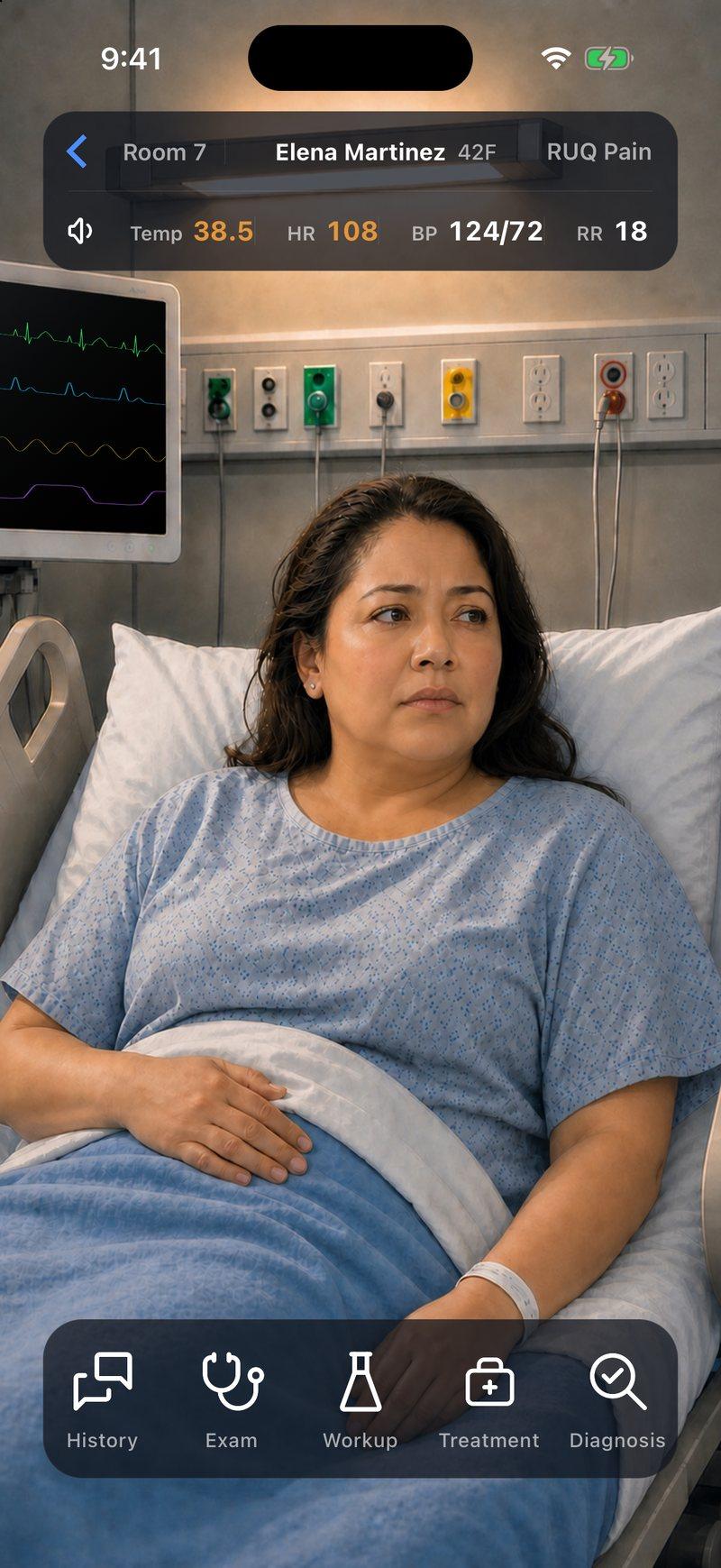
Now make the call yourself
Elena Martinez, 42, has had pain under her right ribs since dinner that has not stopped, with vomiting and a history of shorter, similar episodes. Take her history, examine her, read her ultrasound and decide what needs to happen next.


Elena is a fictional patient, and this page is a summary for learning. Code Status is for training only and is not intended for real-world patient care, diagnosis, treatment, or clinical decision-making.