Code Status case · Advanced · Premium
Cardiac arrest in a 70-year-old man
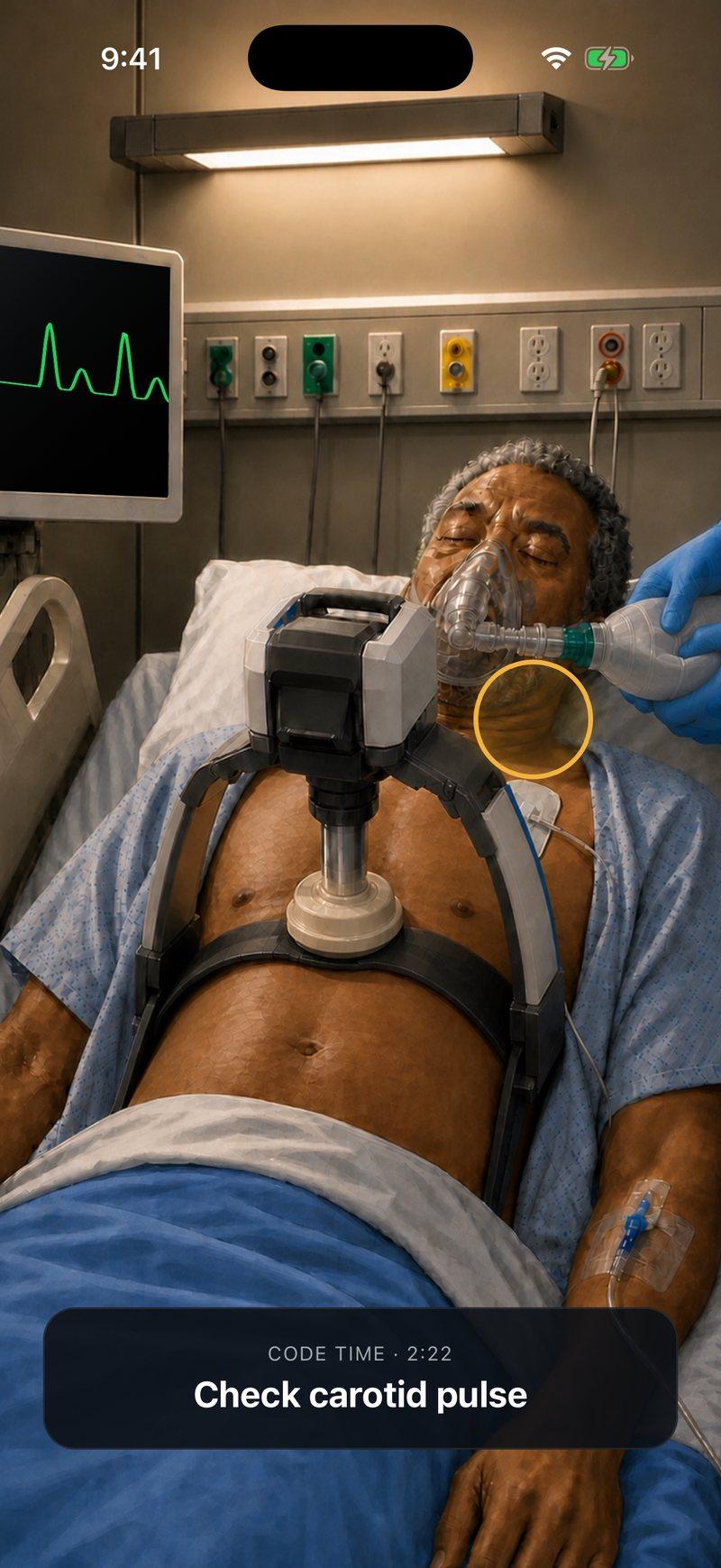
“End-stage renal disease, on dialysis, and he missed his last two sessions. Family watched him collapse. We got there six minutes later with bystander CPR going. He was in PEA and we gave one dose of epinephrine on the way in.”
Your challenge
Walter collapsed at home in front of his family. He has kidney failure, he is on dialysis, and he missed his last two sessions. He arrives in cardiac arrest with CPR under way and one dose of epinephrine (adrenaline) already given. The basics have to be perfect and on time, but the basics alone will not bring him back. A dangerous potassium level, fluid squeezing the heart, a clot in the lungs or a collapsed lung under pressure: finding the right one is what gives him a chance.
After the case, Attending’s Notes explains the decisions that mattered, backed by 10 sources.
Ready to make the call?


Two cases are free. This one is part of Premium.
Spoiler: the diagnosis and what this case teaches
Diagnosis
Cardiac Arrest: Hyperkalemic PEA
Lesson 1
Treat Pulseless Electrical Activity (PEA)
Missed dialysis makes high potassium an urgent reversible cause to consider.
- Treat PEA with CPR, not defibrillation
- Missed dialysis and wide QRS suggest hyperkalemia
- Severe hyperkalemia can occur with a normal ECG
- Do not extend CPR pauses for ultrasound
Lesson 2
Protect the Heart While Arranging Dialysis
Stabilize the heart, shift potassium into cells, and remove it with dialysis.
- Calcium protects the heart without lowering potassium
- Insulin with dextrose moves potassium into cells
- After the pulse returns, add albuterol to lower potassium
- Urgent dialysis removes excess potassium
Lesson 3
Treat Hyperkalemia During CPR
Cause-directed drugs have uncertain survival benefit and do not replace resuscitation.
- Hyperkalemia drugs have uncertain survival benefit
- Bicarbonate is not a reliable way to lower potassium
- A treatable cause may justify longer resuscitation
- Dialysis during CPR needs an expert, equipped team
Lesson 4
After the Pulse Returns, Prevent Another Arrest
Potassium can rebound as temporary treatments wear off.
- ECG improvement does not prove potassium is normal
- Support ventilation and BP after the pulse returns
- Ongoing coma and apnea need airway support
- Monitor glucose for at least six hours after insulin
In the app, every line above opens into the detail behind it: doses, pitfalls and the evidence, with 10 sources linked to the originals.
Walter is a fictional patient. Code Status is for training only and is not intended for real-world patient care, diagnosis, treatment, or clinical decision-making.