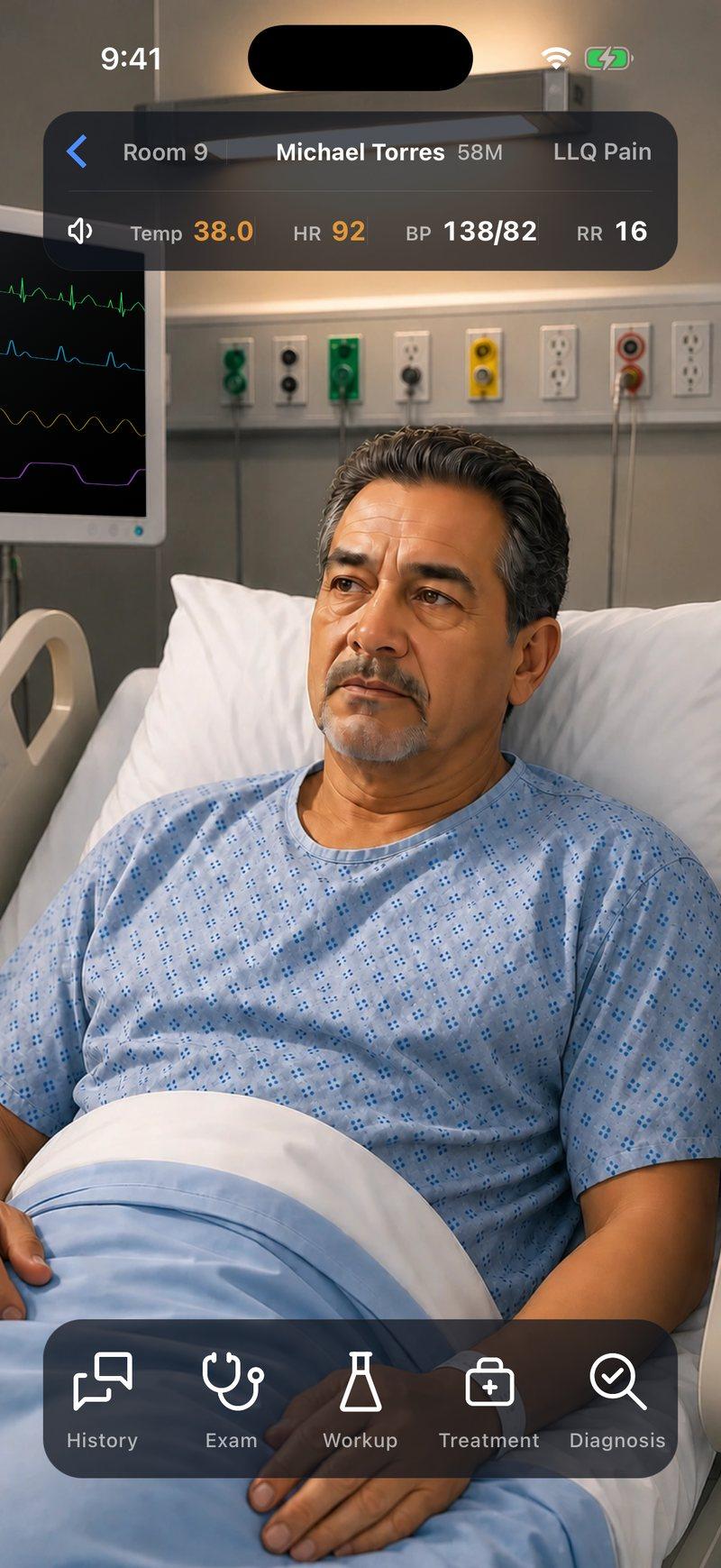
Code Status case · Intermediate · Premium
Lower abdominal pain in a 58-year-old man
“The pain started low in my abdomen and then moved to the left. It has been constant since Sunday.”
“Two days of worsening left-sided abdominal pain. Nauseated, no vomiting, and barely eating.”
Your challenge
Michael's pain began low in his belly on Sunday, settled on the left, and has not moved since. He is nauseated and barely eating, but he has not vomited. Inflamed pouches in the bowel wall, colitis, a kidney stone, a kidney infection and a blocked bowel all belong on the list. The hard part is not naming it: it is proving the problem is simple enough for home, and resisting treatment he may not need.
After the case, Attending’s Notes explains the decisions that mattered, backed by 10 sources.
Ready to make the call?


Two cases are free. This one is part of Premium.
Spoiler: the diagnosis and what this case teaches
Diagnosis
Acute Diverticulitis
Lesson 1
Persistent LLQ Pain Suggests Diverticulitis
Diverticula are common. Inflammation makes this diverticulitis.
- Diverticulitis means inflamed colon pouches
- Constant LLQ pain supports diverticulitis
- Fever supports diverticulitis but may be absent
- Left lower quadrant pain has other causes
Lesson 2
CT Shows Complications That Change Treatment
Look for abscess or perforation.
- Inflamed sigmoid and fat suggest diverticulitis
- Intravenous contrast helps identify an abscess
- Abscess, perforation, or obstruction complicate
- Larger abscesses may also need drainage
- Check for complications when CT shows diverticulitis
Lesson 3
Not All Diverticulitis Needs Antibiotics
Not every uncomplicated case needs a prescription.
- Mild uncomplicated disease may need no antibiotics
- Give antibiotics for higher severity or risk
- If treating, target gram negatives and anaerobes
- Reassess the patient who is not improving
Lesson 4
Decide Who Can Go Home
Home needs symptom control and intake.
- Control the pain, then test oral intake
- Discharge needs stability and no CT complication
- Admit for sepsis or complications
- Peritonitis or obstruction needs surgical evaluation
- Plan whether colonoscopy is needed after recovery
- Explain when to return urgently
In the app, every line above opens into the detail behind it: doses, pitfalls and the evidence, with 10 sources linked to the originals.
Michael is a fictional patient. Code Status is for training only and is not intended for real-world patient care, diagnosis, treatment, or clinical decision-making.