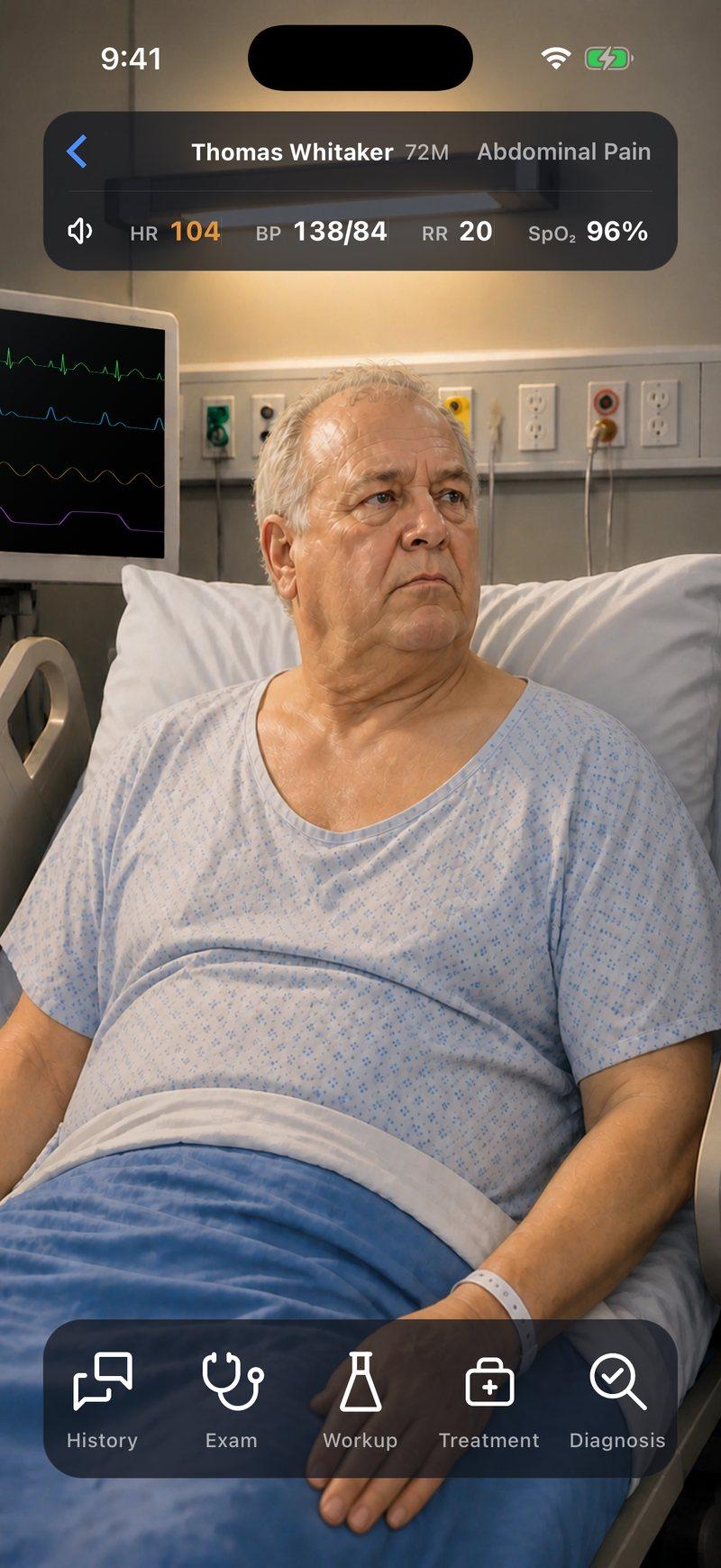
Code Status case · Advanced · Premium
Abdominal pain in a 72-year-old man
“It's my stomach and my back. Probably strained something. My wife made me come in.”
“Abdominal and lower back pain since two this afternoon. Smoker with hypertension and high cholesterol. Sweaty but says he's fine. CT is backed up about forty minutes.”
Your challenge
Thomas says he probably strained something, he has had worse, and he would rather be home. He is 72, he smokes, he has high blood pressure, and he is sweaty while telling you he is fine. The CT scanner is backed up forty minutes. An inflamed pancreas, a gut losing its blood supply, a burst pouch in the bowel, a heart attack or a problem with the body's main artery can all hurt like this, and only some of them can wait for a scan. This case asks how fast you can think, and what you will do if you run out of time.
After the case, Attending’s Notes explains the decisions that mattered, backed by 10 sources.
Ready to make the call?


Two cases are free. This one is part of Premium.
Spoiler: the diagnosis and what this case teaches
Diagnosis
Ruptured Abdominal Aortic Aneurysm
Lesson 1
Sudden Pain With Low BP Suggests Rupture
Sudden abdominal or back pain with collapse or low blood pressure: assess the aorta.
- Sudden back pain and collapse fit aortic rupture
- No palpable mass does not exclude aortic rupture
- Flank pain with shock warrants aortic evaluation
- Normal pressure can mask major blood loss
Lesson 2
Use CT Angiography Only When Safe to Scan
Unstable suspected rupture needs vascular surgery without imaging delay.
- Ultrasound finds aneurysm but cannot exclude rupture
- If stable, CTA confirms rupture and guides repair
- Unstable aneurysm needs vascular surgery now
Lesson 3
Support Perfusion While Arranging Repair
Large-bore IV access, blood, and early vascular surgery involvement. Use crystalloid only as a bridge.
- Large-bore IVs and early type and screen
- Transfuse early for major blood loss
- Before repair, support perfusion, not normal BP
- A brief pressure rise does not prove bleeding stopped
Lesson 4
Keep Treating Hemorrhage During Cardiac Arrest
Give blood and arrange aortic control while standard arrest care continues.
- Severe blood loss can cause pulseless electrical activity
- Give arrest care and blood together
- Keep emergency aortic repair moving
- Aortic control stays urgent after the pulse returns
In the app, every line above opens into the detail behind it: doses, pitfalls and the evidence, with 10 sources linked to the originals.
Thomas is a fictional patient. Code Status is for training only and is not intended for real-world patient care, diagnosis, treatment, or clinical decision-making.