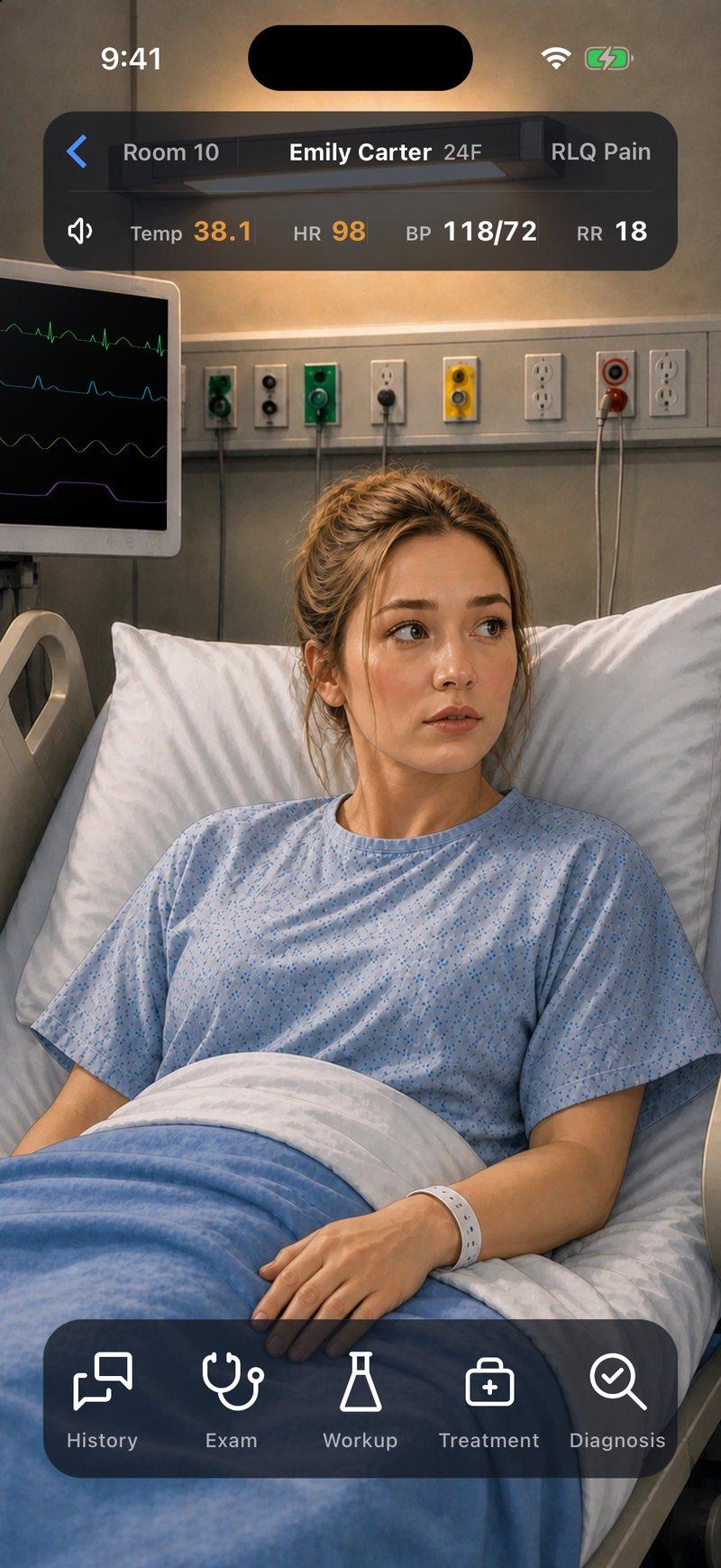
Code Status case · Intermediate · Premium
Lower abdominal pain in a 24-year-old woman
“I thought it was something I ate but it's been getting worse all night.”
“Eighteen hours of abdominal pain that started centrally and moved to the right lower quadrant. Vomited twice and hasn't eaten since yesterday. She's very uncomfortable.”
Your challenge
Emily thought it was something she ate. Eighteen hours later the pain has moved from the middle of her belly to the lower right, she has vomited twice, and moving makes it worse. In a young woman that pain has more than one source: the appendix, a pregnancy in the wrong place, a twisted ovary, a stomach bug or a kidney stone. Ruling them out in the right order matters, and so does the treatment choice that follows, because there is more than one reasonable path.
After the case, Attending’s Notes explains the decisions that mattered, backed by 11 sources.
Ready to make the call?


Two cases are free. This one is part of Premium.
Spoiler: the diagnosis and what this case teaches
Diagnosis
Acute Appendicitis
Lesson 1
Migrating RLQ Pain Suggests Appendicitis
An atypical sequence does not exclude the diagnosis.
- Pain moving to the RLQ suggests appendicitis
- Appendicitis pain usually starts before nausea
- Focal RLQ tenderness raises suspicion
- Symptoms vary with age and pregnancy
Lesson 2
Imaging Confirms and Checks Complications
Appendix size alone is not enough to establish the diagnosis.
- Check pregnancy status before the scan
- An enlarged, inflamed appendix fits appendicitis
- Free gas or abscess suggests complication
- Start with ultrasound in children and pregnancy
Lesson 3
Surgery Is Definitive, Antibiotics May Work
An appendicolith raises the failure rate.
- Consult general surgery once appendicitis is confirmed
- Give antibiotics before appendectomy
- Selected cases can start with antibiotics
- An appendicolith lowers antibiotic-only success
- Explain recurrence risk before choosing antibiotics
Lesson 4
Peritonitis or Sepsis Needs Source Control
A stable, contained abscess may follow a different surgical plan.
- Diffuse peritonitis or sepsis needs urgent surgical care
- An abscess or phlegmon needs a surgical plan
- An appendicolith does not prove perforation
- Deterioration means immediate reassessment
In the app, every line above opens into the detail behind it: doses, pitfalls and the evidence, with 11 sources linked to the originals.
Emily is a fictional patient. Code Status is for training only and is not intended for real-world patient care, diagnosis, treatment, or clinical decision-making.