Code Status case · Beginner · Premium
Chest pain in a 31-year-old man
“It hurts to breathe. Am I having a heart attack?”
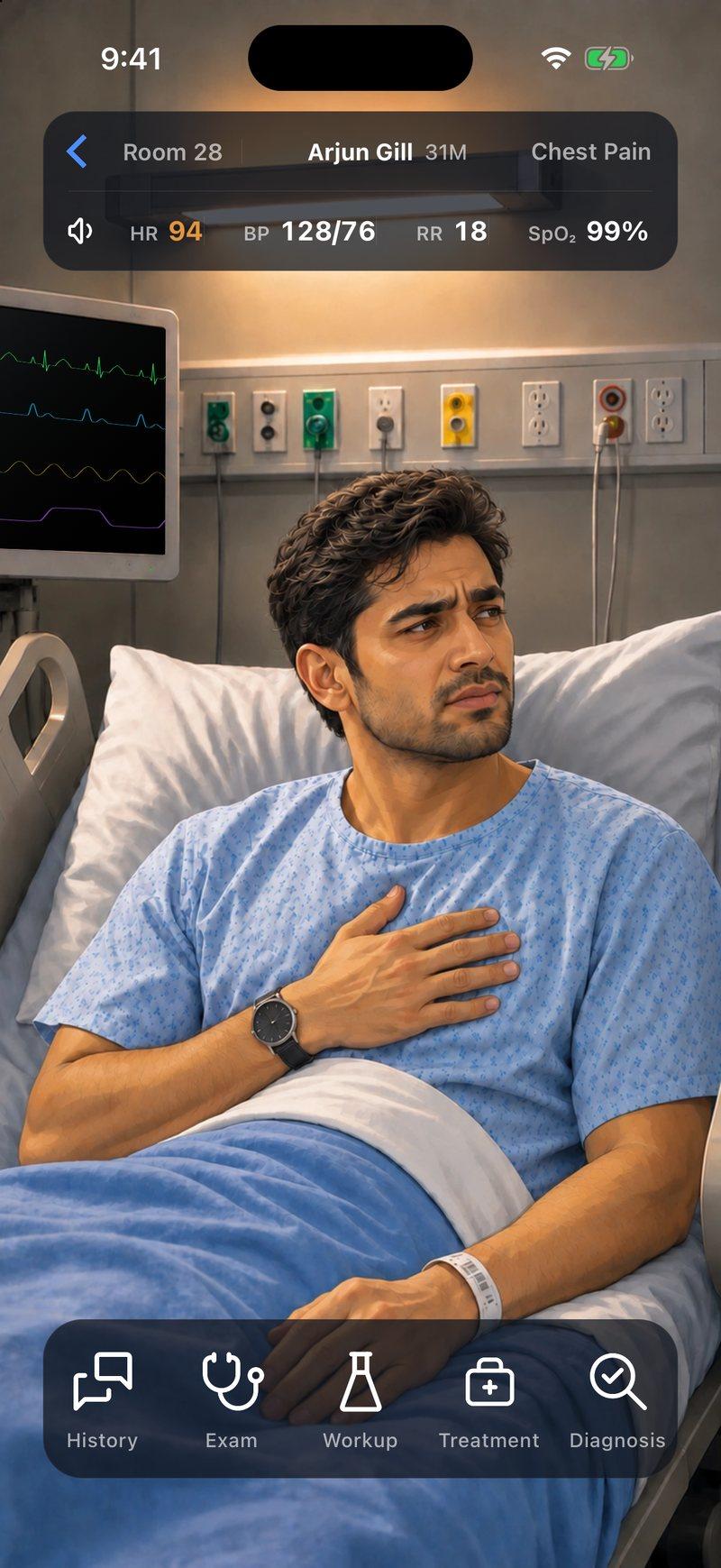
“Sharp chest pain since about ten last night, worse when he takes a deep breath. His fiancée drove him in. He looks uncomfortable, but well.”
Your challenge
Arjun asks you straight out: am I having a heart attack? His pain is sharp, it has lasted since ten last night, and it gets worse when he breathes in. A collapsed lung, a clot, a strained chest wall and a heart attack can all start this way. An ECG may be the most important clue, but interpreting it correctly matters more than simply recognizing an abnormal tracing. Your decisions determine what happens next.
After the case, Attending’s Notes explains the decisions that mattered, backed by 10 sources.
Ready to make the call?


Two cases are free. This one is part of Premium.
Spoiler: the diagnosis and what this case teaches
Diagnosis
Acute Pericarditis
Lesson 1
Arjun's Story Pointed to Pericarditis
Pericarditis pain is classically positional.
- Sharp chest pain, worse lying flat
- Better sitting up or leaning forward
- Often follows a viral illness, like his cold
- A friction rub supports the diagnosis
- His workup made the look-alikes unlikely
Lesson 2
Not Every ST Elevation Is a STEMI
Widespread ST elevation with PR depression should make you think pericarditis.
- Arjun's ECG was acute pericarditis
- STEMI usually follows one coronary territory
- Reciprocal ST depression favors STEMI
- If unsure, get an echo and call cardiology
Lesson 3
An NSAID Plus Colchicine Treats It
Treat acute pericarditis with an NSAID or aspirin plus colchicine.
- Ibuprofen 600 mg three times daily, then taper
- Add colchicine 0.5 mg twice daily for 3 months
- Protect the stomach with a proton pump inhibitor
- Avoid steroids as routine first-line treatment
Lesson 4
Low-Risk Pericarditis Goes Home
Low-risk acute pericarditis usually does not need admission.
- Admit for fever, large effusion, or NSAID failure
- Low-risk patients go home with follow-up
- No strenuous exercise for at least 1 month
- Return for breathlessness or lightheadedness
In the app, every line above opens into the detail behind it: doses, pitfalls and the evidence, with 10 sources linked to the originals.
Arjun is a fictional patient. Code Status is for training only and is not intended for real-world patient care, diagnosis, treatment, or clinical decision-making.