Code Status case · Beginner · Premium
Flank pain in a 36-year-old man
“I can't get comfortable, no matter how I move.”
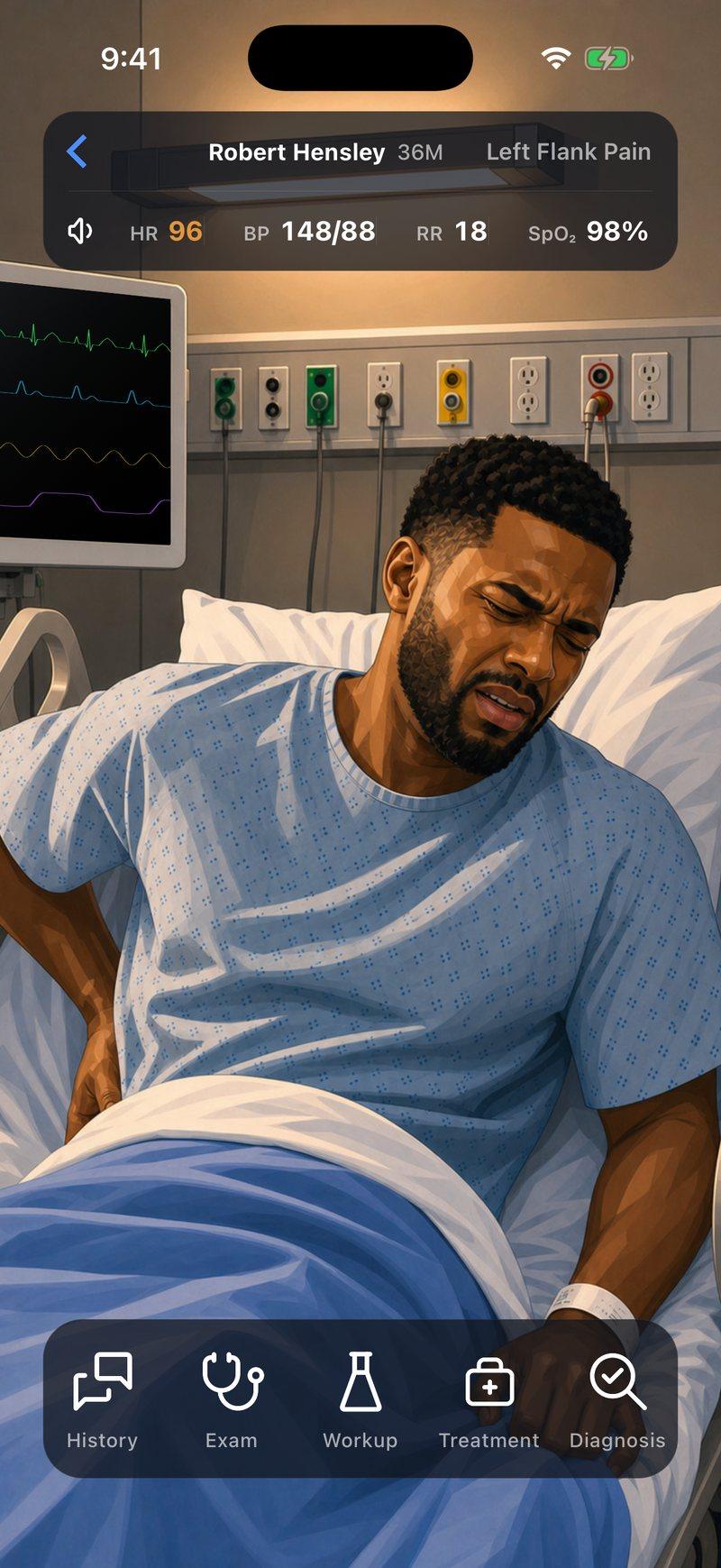
“Sudden left flank pain for about three hours. Restless, can't get comfortable. Nauseated and vomited once. He's in a lot of pain.”
Your challenge
Robert cannot keep still. His left side has hurt for three hours, he has vomited once, and no position helps. Appendicitis, a kidney stone, a kidney infection, a twisted testicle and a pulled muscle can all start like this. Pain relief comes first, but the real decisions are which scan to order, what makes this an emergency instead of a bad day, and when it is safe to send him home.
After the case, Attending’s Notes explains the decisions that mattered, backed by 10 sources.
Ready to make the call?


Two cases are free. This one is part of Premium.
Spoiler: the diagnosis and what this case teaches
Diagnosis
Renal Colic
Lesson 1
Flank Pain and Blood in Urine Suggest a Stone
A classic pattern can strongly suggest a stone. It does not prove one.
- Sudden flank pain in waves suggests renal colic
- Blood in urine supports a stone but does not prove it
- Broaden workup for fever or abnormal abdominal exam
Lesson 2
Obstruction Plus Infection Is the Emergency
Antibiotics alone may not control infection behind a blockage.
- Hydronephrosis means urine is backing up
- Infection plus obstruction needs urgent drainage
- No single test excludes infection with obstruction
- Involve urology early when kidney function is threatened
Lesson 3
Use CT When Stone Details or Alternatives Matter
Ultrasound may answer the immediate question with no radiation.
- CT shows stone size, location, and other causes
- Ultrasound can show hydronephrosis
- Abdominal X-rays cannot reliably exclude a stone
- Not every stone patient needs a scan today
Lesson 4
Discharge Needs Symptom Control and Kidney Safety
Pain control matters but discharge depends on the whole reassessment.
- Start an NSAID if kidney and bleeding risks allow
- Give fluids for dehydration, not to flush the stone
- Smaller stones near the bladder pass more often
- Control symptoms and confirm kidney safety
In the app, every line above opens into the detail behind it: doses, pitfalls and the evidence, with 10 sources linked to the originals.
Robert is a fictional patient. Code Status is for training only and is not intended for real-world patient care, diagnosis, treatment, or clinical decision-making.